
Brand Mentions vs Backlinks: Why AI Prefers Mentions
Authors



Brand Mentions vs Backlinks: Why AI Prefers Mentions
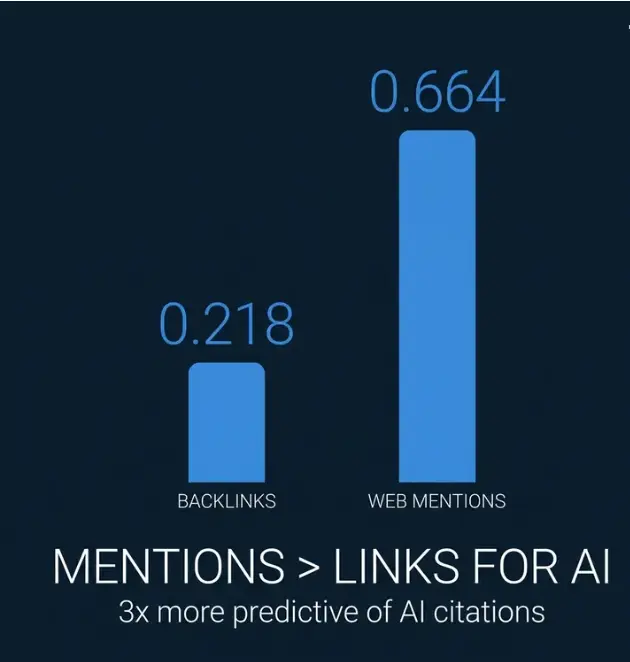
TL;DR: Ahrefs analyzed 75,000 brands and found branded web mentions correlate 3x stronger with AI visibility (0.664) than backlinks (0.218). Brands in the top 25% for mentions averaged 169 AI appearances. Brands in the bottom 50% averaged near zero. AI systems prioritize textual patterns over link graphs because they learn from context, not hyperlinks. High-quality mentions require distribution across credible sources, contextual relevance, and volume thresholds. Building mention equity as infrastructure beats campaign-based tactics.
Brand Mentions vs Backlinks: What is the Difference?
Brand mentions are textual references to a company, product, or person on the web without a hyperlink, whereas backlinks are clickable hyperlinks connecting one website to another. While traditional search engines rely on backlinks to measure page authority, modern AI search engines analyze brand mentions to build semantic associations and determine entity trust.
Core Answer:
- Brand mentions correlate 0.664 with AI visibility versus 0.218 for backlinks (3x difference)
- Top 25% of brands for web mentions averaged 169 AI appearances, bottom 50% averaged near zero
- AI systems recognize brands through semantic associations in text, not link authority
- High-signal mentions need contextual relevance, source quality, distribution, and frequency
- Mention equity compounds when treated as infrastructure, not campaigns
Your backlink strategy expired. AI systems stopped looking for link authority.
A landmark data study by Ahrefs analyzing 75,000 brands revealed a critical shift that the market missed. Branded web mentions correlate with Google AI Overview appearances at 0.664. Backlinks correlate at 0.218.
Mentions are three times more predictive of AI citations than link authority.
This is measured data from Google AI Overviews, ChatGPT, and Perplexity. The research shows a visibility cliff. Brands in the top 25% for web mentions averaged 169 AI appearances. Bottom 50% averaged near zero.
Here is what this means for your business.
Brand Mentions for AI Search: How LLMs Learn Authority
Traditional search engines built authority through links. PageRank treated backlinks as votes. More links from authoritative sites meant higher rankings.
Large language models (LLMs) work differently.
LLMs train on massive text corpora. When your brand name appears in articles, reviews, forums, videos, and discussions, the model builds semantic associations. The system learns your brand is relevant, authoritative, and trustworthy in specific contexts.
Unlinked brand mentions move the needle. The AI does not need a hyperlink to understand context. The system needs textual patterns connecting your brand to the problems it solves.
A follow-up study tested the same 75,000 brands across ChatGPT and Google AI Mode. Branded web mentions remained one of the strongest signals on every platform, ranging from 0.66 to 0.71. YouTube mentions performed stronger at 0.737 because video transcripts are part of the training data.
The mechanism is straightforward. AI systems recognize brands as entities in their knowledge graph. When authoritative publications mention a brand, the AI learns associations between your brand and specific topics. The surrounding context provides the signals AI systems use to determine relevance.
Bottom line: AI systems learn from textual patterns, not link graphs. Mentions build semantic associations. Links signal page authority for traditional rankings.
The Gap: Building Authority Signals AI Systems Cannot Interpret
You are investing in backlinks because backlinks worked for traditional search. AI visibility operates on different infrastructure.
The diagnostic gap: you are building link authority while AI systems are looking for contextual mention equity.
Here is what happens.
You run a link-building campaign. You get placements on decent sites. Your Domain Rating improves. Your traditional rankings move up.
When buyers ask AI systems for recommendations in your category, you are invisible.
The mentions you earned were thin. Generic. List-style placements with minimal surrounding context. The kind of coverage that registers as noise in the training data, not signal.
Analysis shows Machine learning analysis shows that AI engines do not simply count brand occurrences; instead, they evaluate the semantic density of the surrounding text. A mention connecting your brand to a specific problem, explaining how you solve the problem, and showing real outcomes gives the model strong signals.
A generic mention on a big site does not create those patterns. People scrolling see the mention. AI systems deciding what to recommend have little to work with.
Key point: Link authority builds traditional search rankings. Mention equity builds AI visibility. The infrastructure is different. The signals are different.
What Qualifies as a High-Quality Mention
Not all mentions are equal. The Ahrefs correlation is not driven by "any mention exists." The correlation is driven by mentions crossing a threshold of quality, relevance, frequency, and distribution.
High-signal mentions do three things.
They appear in relevant, high-trust contexts. The surrounding text connects your brand to the topics buyers care about. A mention in a detailed comparison article or expert roundup on a respected industry site carries more weight than a name-drop in a "top 50 tools" list or a low-quality directory.
They accumulate with real distribution and frequency. One or two mentions, even good ones, usually register as noise. You need to be in the upper range of mention frequency for your category before AI systems treat the mentions as a reliable signal.
They help with entity recognition and disambiguation. Strong mentions include enough surrounding context for the model to confidently link the name to the right company, product, and use case. Vague or conflicting mentions do not build clarity.
When auditing current mentions, look for these six factors:
- Source quality and E-E-A-T: Editorial publications, respected review platforms, and niche authority sites beat random blogs or press release wires.
- Contextual relevance: Is the brand mentioned while actually discussing the problem and solution, or is it just listed?
- Natural language: Natural usage in sentences versus keyword-stuffed or directory-style listings.
- Distribution: Mentions spread across many different domains, not all coming from one or two sites.
- Recency: Fresh mentions carry more weight because training data and retrieval systems often prioritize newer content.
- Volume threshold: You generally need to be in the upper range of mention frequency for your category before AI systems treat it as a reliable signal.
Research analyzing over one million AI-cited links found 82% come from earned media and 94% come from non-paid sources. Brands in the bottom 50% of web mentions are invisible to AI systems regardless of SEO performance.
Key point: Quality, distribution, and frequency determine whether mentions register as signal or noise. Most brands have some mentions. Few have reached the threshold where mentions create AI visibility.
Mention Equity vs Link Building: Which Matters More for AI?
Backlinks still matter for traditional rankings. Many AI Overview citations come from pages ranking well in classic search. Strong backlinks help you earn those rankings and the initial visibility leading to citations.
The data shows diminishing returns for AI-specific outcomes once you move past a certain level of link authority.
The contrast is structural.
Link-building campaigns are temporary and transactional. You pay for placements. You get links. The campaign ends. The links remain. The process does not compound without continued investment.
Mention equity is structural, compounding, and owned. When you build referenceable assets, original research, customer proof, and thought leadership, third parties cite you naturally. Those mentions generate more mentions. The flywheel builds momentum.
AI mentions have staying power. Unlike social posts fading quickly from feeds, brand mentions on the open web remain indexed and searchable for years. AI systems pull from both historical training data and fresh web searches. A single mention today keeps resurfacing in answers months or years from now.
The smartest approach: links plus mentions working together. Links for ranking power. Mentions for AI trust and citation likelihood.
Key point: Link building and mention equity serve different systems. Traditional search weighs links. AI systems weigh textual patterns. The businesses winning long term build both.
How to Measure Mention Equity
Track two indicators.
Leading indicator: web mention equity. Total volume of branded web mentions across credible sources. Distribution spread across many independent domains. Quality signals like source authority and contextual relevance. Trend over time showing if the stock of high-signal mentions is growing quarter over quarter.
The goal is to move from "some mentions" into the top quartile for your category. This is where the research shows AI visibility jumps.
Lagging indicator: actual AI visibility. Number of times the brand appears in AI answers across target queries on Google AI Overviews, ChatGPT, Perplexity, and other platforms. Share of voice in category-relevant AI responses. Consistency of appearance, not occasional spikes.
Run periodic AI visibility audits monthly or quarterly alongside web mention tracking.
The strongest confirmation: you see both web mention volume and distribution moving into or staying in the top quartile, and a corresponding, sustained increase in actual AI citations.
When both move together, the brand is no longer noise. The model is now consistently recognizing and surfacing the brand as a relevant answer.
Use tools like Ahrefs Brand Radar for web mention tracking and quartile positioning. Run manual or tool-assisted audits of AI outputs for target queries. Build a simple dashboard showing both the input (mention equity) and output (AI appearances) over time.
This dual view prevents celebrating mention volume spikes not translating into AI recognition, or seeing random AI mentions without the underlying mention equity foundation.
Key point: Track both leading indicators (mention volume, distribution, quality) and lagging indicators (AI appearances). The goal is top-quartile positioning for your category. Below that threshold, you stay invisible.
Building Mention Equity as Infrastructure Investment
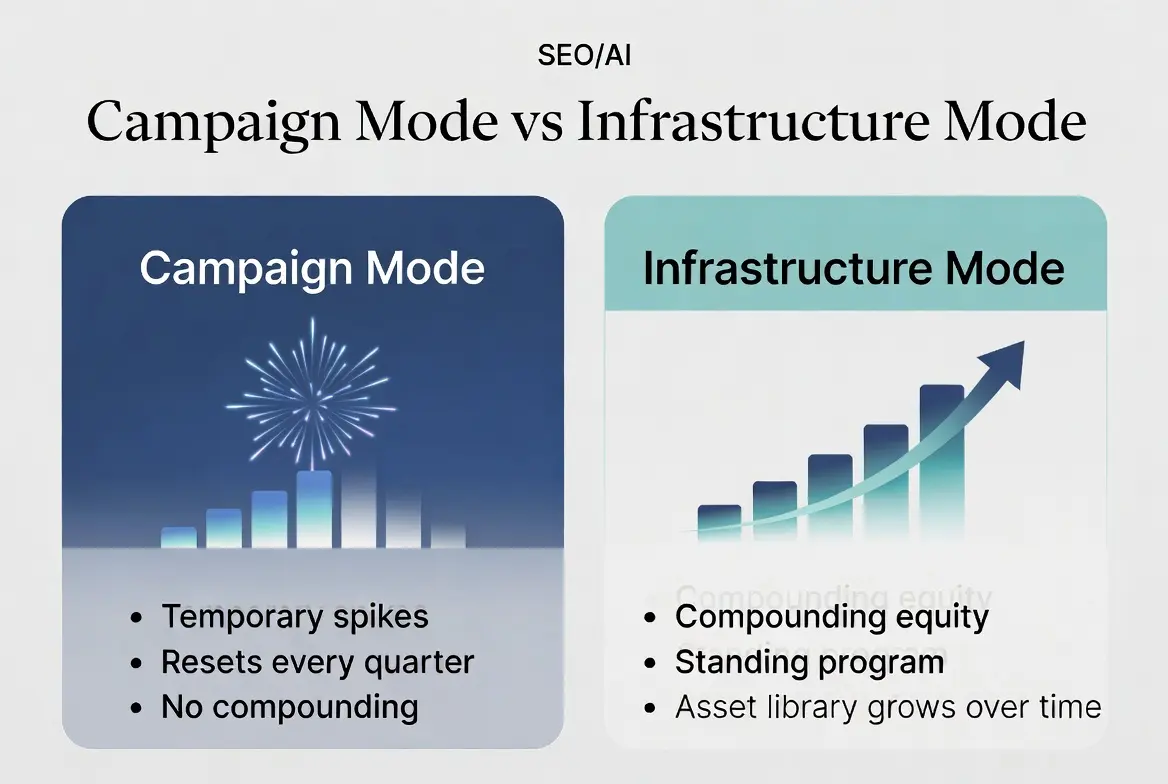
Most businesses treat mention building as a campaign or quarterly initiative. They extract some insights, package one or two assets, get coverage, then move on. Mention equity resets or grows slowly.
To make mention equity compound, shift from project-based work to a permanent operating system.
Make mention equity a standing program, not a campaign. Stop thinking in terms of quarterly mention initiatives. Treat mention equity development as an ongoing business function, similar to content marketing or customer success. Dedicate or assign fractional ownership to someone whose performance is measured on the quality and distribution of third-party mentions. Establish a recurring operating rhythm monthly or quarterly instead of ad hoc projects. Build a growing library of referenceable assets rather than one-off reports.
Build a compounding asset library. Each new asset builds on previous ones rather than starting from scratch. Turn one framework into a full benchmark study the next year. Use data from last year's research as a baseline for this year's update. Create "State of X" reports refreshed annually. These are highly citable. Develop a core methodology expanded with new customer data over time.
This creates a flywheel. Existing assets generate coverage. Coverage surfaces new customer stories and data. Those become inputs for the next asset.
Institutionalize tacit knowledge extraction. Do not wait for someone to have an insight. Build light processes to capture patterns continuously. Quarterly pattern reviews with customer-facing teams. Simple templates for capturing what you are seeing that others are not. Post-implementation or win/loss reviews feeding into the asset pipeline.
When extraction becomes habitual, you always have fresh raw material instead of scrambling when you need new coverage.
Add amplification loops. High-signal mentions generate more high-signal mentions. Use strong coverage to attract better speaking opportunities and analyst briefings. Turn customer stories appearing in third-party content into new case studies or research inputs. Leverage existing relationships with journalists and analysts for recurring access.
Measure what compounds. Shift measurement from "mentions this quarter" to tracking the stock of mention equity over time. Total volume of high-quality mentions tracked quarterly or annually. Distribution across sources. Share of voice in substantive coverage. Progress toward or maintenance of top-quartile positioning.
This prevents celebrating a spike and then letting the program go dormant.
Key point: Campaign-based mention building produces temporary spikes. Infrastructure-based mention equity produces compounding returns. The difference is ownership, recurring rhythms, and asset libraries building on previous work.
Timeline from Start to Consistent AI Citations
The question we hear: how long does this take?
The honest answer: where you start determines the timeline.
If you already have some mention volume and distribution, you start seeing AI citations within 30 to 60 days of implementing a focused mention equity strategy.
If you are starting from near zero, crossing into the top quartile usually takes 90 to 120 days of consistent execution. Building the referenceable assets, earning the coverage, and accumulating enough distributed mentions for AI systems to recognize the pattern.
The timeline is not the hard part. The hard part is shifting from campaign thinking to infrastructure thinking.
Campaign thinking asks: what do we do this quarter to get more mentions?
Infrastructure thinking asks: what system do we build so every quarter we have more high-signal referenceable material than the quarter before, and the process gets easier over time?
The businesses winning AI visibility long term stop treating mention equity like a marketing campaign and start treating the process as an accumulating business asset.
Key point: Timelines range from 30 to 120 days depending on your starting position. The bigger shift is mental. Campaign thinking produces spikes. Infrastructure thinking produces compounding equity.
What to Do Next
Start by auditing your current brand mention footprint versus competitors. Use AI Search Strategies AI Visibility Engine, Ahrefs Brand Radar, or similar tools to see where you stand in your category.
Then pick two to three tactics to execute consistently over the next 90 days:
- Run a consistent PR and media outreach program. Pitch relevant journalists and niche publications with original data, unique angles, or expert commentary.
- Publish mention-worthy content regularly. Original research, industry benchmarks, controversial but well-supported takes, free tools or resources, or annual reports get shared and cited far more than standard blog posts.
- Double down on review and comparison platforms. Actively manage your presence on G2, Capterra, TrustRadius, and industry-specific review sites. These are frequently referenced in AI answers.
- Engage authentically in communities. Participate, don't just promote, on Reddit, Indie Hackers, relevant Slack or Discord groups, and niche forums. Thoughtful answers often get quoted elsewhere.
- Leverage video and YouTube strategically. Create educational or commentary videos. Even guest appearances or podcast clips on other channels count as strong mentions.
- Build strategic partnerships and co-marketing. Joint webinars, co-authored content, customer case studies, or integration spotlights with complementary tools or brands generate natural third-party coverage.
The 0.664 correlation is not a reason to abandon SEO. The correlation is a signal to evolve your approach.
Brands combining smart link building with deliberate, high-quality mention-earning activities are positioning themselves to win both classic rankings and the new AI layer.
The research is clear. The opportunity is happening now.
Frequently Asked Questions
Why do brand mentions correlate stronger with AI visibility than backlinks?
AI systems train on text, not link graphs. LLMs (large language models) learn from contextual patterns in massive text corpora. When your brand appears repeatedly in relevant contexts across credible sources, the model builds semantic associations. Backlinks signal page authority for traditional search engines. Mentions signal entity recognition and relevance for AI systems. The infrastructure is different.
What is the minimum number of mentions needed to appear in AI results?
There is no fixed number. The Ahrefs research shows a threshold effect. Brands in the top 25% for web mentions in their category averaged 169 AI appearances. Brands in the bottom 50% averaged near zero. The requirement is reaching the upper range of mention frequency for your specific category, distributed across multiple credible sources with contextual relevance.
Do unlinked mentions help with AI visibility?
Yes. AI systems do not need hyperlinks to understand context. They need textual patterns. A mention in an article, review, forum post, or video transcript contributes to semantic associations whether or not a link is present. The surrounding context matters more than the link itself.
How long does mention equity take to build?
Timelines depend on your starting position. If you already have mention volume and distribution, you start seeing AI citations within 30 to 60 days. If you are starting from near zero, crossing into the top quartile usually takes 90 to 120 days of consistent execution. The bigger challenge is not the timeline. The bigger challenge is shifting from campaign thinking to infrastructure thinking.
Should we stop building backlinks?
No. Backlinks still matter for traditional rankings. Many AI Overview citations come from pages ranking well in classic search. The smartest approach: links plus mentions working together. Links for ranking power. Mentions for AI trust and citation likelihood. Build both.
What makes a mention high-quality for AI systems?
High-quality mentions cross thresholds in six areas. Source quality and E-E-A-T (editorial publications, respected review platforms, niche authority sites). Contextual relevance (the brand is discussed while addressing the problem and solution). Natural language (natural usage in sentences versus keyword-stuffed listings). Distribution (mentions spread across many independent domains). Recency (fresh mentions carry more weight). Volume threshold (upper range of mention frequency for your category).
How do we measure if mention equity is working?
Track two indicators. Leading indicator: web mention equity (total volume, distribution, quality, trend over time). Lagging indicator: actual AI visibility (number of times your brand appears in AI answers across Google AI Overviews, ChatGPT, Perplexity, and other platforms). The strongest confirmation: both moving together. Web mention volume and distribution entering or staying in the top quartile, and a corresponding, sustained increase in actual AI citations.
What is the difference between mention equity and link building?
Link-building campaigns are temporary and transactional. You pay for placements. You get links. The campaign ends. The links remain. The process does not compound without continued investment. Mention equity is structural, compounding, and owned. When you build referenceable assets, original research, customer proof, and thought leadership, third parties cite you naturally. Those mentions generate more mentions. The flywheel builds momentum.
Key Takeaways
- Brand mentions correlate 0.664 with AI visibility versus 0.218 for backlinks (3x difference based on Ahrefs analysis of 75,000 brands)
- Brands in the top 25% for web mentions averaged 169 AI appearances. Bottom 50% averaged near zero (sharp visibility cliff)
- AI systems train on text, not link graphs. They build semantic associations from contextual patterns, not hyperlink topology
- High-signal mentions require six factors: source quality, contextual relevance, natural language, distribution across domains, recency, and volume threshold
- 82% of AI-cited links come from earned media, 94% from non-paid sources (research analyzing over one million AI-cited links)
- Mention equity compounds when treated as infrastructure (standing program, recurring rhythms, asset libraries) instead of campaigns
- Timeline: 30 to 60 days with existing mention volume, 90 to 120 days starting from near zero. The bigger challenge is shifting from campaign thinking to infrastructure thinking
Is your business invisible to AI?
Get a manual expert analysis to uncover why you aren't being recommended.
Get Your Free AI Visibility Quick Win Review