
Make Your Local Business the Go-To Recommendation for AI Chatbots with Artificial Intelligence Search Engine Optimization
Authors


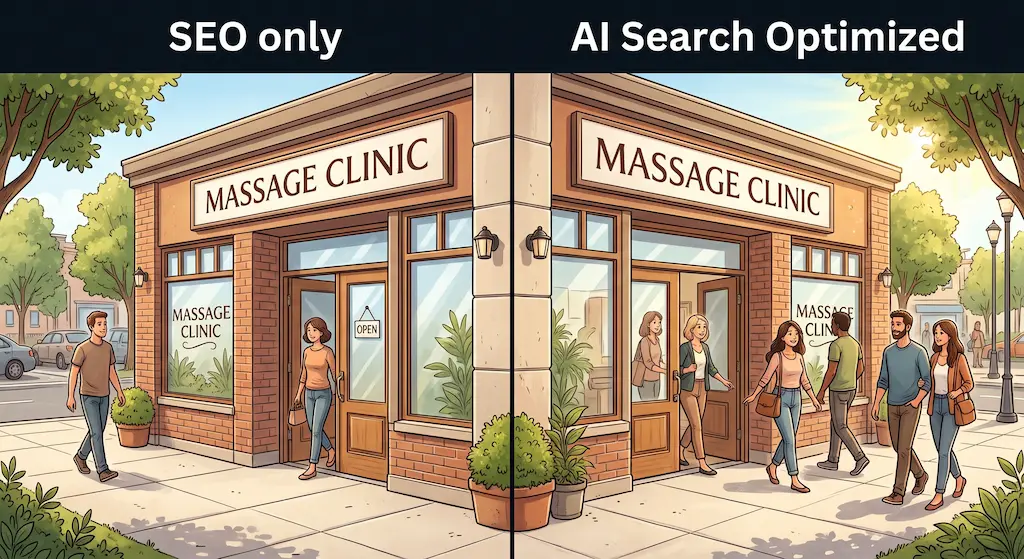
Picture this: a Calgary accounting firm has held a page-one Google ranking for three years. Reviews are solid, the website is clean, and the phone used to ring. Then a prospective client opens ChatGPT, types "Who's the best accountant near me in Calgary?" and gets three confident recommendations. That firm isn't among them. It doesn't exist in that answer, and it never will, unless something fundamental changes about how it presents itself to AI systems.
Artificial intelligence search engine optimization (AI SEO) is the discipline of structuring your digital presence so that LLM-powered tools like ChatGPT, Gemini, and Perplexity recognize your business, trust what they find, and recommend you by name. Often abbreviated as AISO, it's a distinct practice from traditional SEO, one that addresses how AI systems evaluate entity confidence rather than how search engines rank pages. Running AI visibility audits across local service businesses, the same pattern keeps surfacing: strong Google rankings, zero AI presence. These are not the same problem, and closing the gap requires understanding how each system actually works.
This article covers how AI-driven discovery works, the specific tactics that move a business from invisible to recommended, and what a structured audit process typically finds when it digs into a real local business site.
What artificial intelligence search engine optimization actually means
Artificial intelligence search engine optimization is not SEO with a new coat of paint. Traditional search engines crawl pages, score them against hundreds of ranking signals, and return a list. LLM-powered systems do something different: they combine language model capabilities with retrieval from external sources and structured entity signals to judge confidence for recommendations. They are not ranking your page; they are deciding whether they know enough about your business to stake a recommendation on it.
That said, Google's own Search Central documentation makes clear that strong generative AI visibility is built on the same foundation as good SEO, accurate structured data, solid technical practices, and content that answers specific questions clearly. AISO extends that foundation rather than replacing it. The AI-powered search optimization layer sits on top of technical SEO fundamentals; businesses that skip the fundamentals will struggle with both.
You may have seen this framed as GEO (generative engine optimization) or AEO (AI engine optimization). The terminology varies, but the underlying shift is consistent: discovery is moving from keyword-match retrieval to entity-confidence generation. A business that hasn't built its entity signal infrastructure isn't competing on a different playing field, it's not on the field at all.
How LLMs decide which businesses to recommend
LLM-powered systems determine local business recommendations through a combination of entity recognition, structured signal confidence, and source trust. Entity recognition means the model has enough corroborating data across the web to identify your business as a real, distinct thing. Structured signal confidence means your name, address, phone number, and service descriptions are consistent enough across directories, your website, and third-party sources that the model doesn't second-guess the details. Source trust means the information is verifiable from enough credible points that the model can recommend you without generating a hallucinated answer.
Why Google rankings and AI recommendations don't always overlap
Google's ranking algorithm rewards backlinks, keyword density, page speed, and click-through patterns. LLM-powered tools weight entity clarity, structured facts, and citation consistency more heavily. A business can optimize obsessively for Google and still be functionally invisible to AI because the two systems read different signals from different data sets. This is the two-system problem, and it explains why businesses that already invest in SEO often need dedicated AI-driven search ranking signals to show up in AI-generated answers.
Why local service businesses face the greatest AI visibility risk
According to BrightLocal's 2026 Local Consumer Review Survey, 45% of consumers now use AI tools like ChatGPT for local business recommendations, up from 6% in 2025. The channel grew by 39 percentage points in a single year. For local service businesses, contractors, physiotherapy clinics, accountants, renovation firms, that growth curve is the competitive threat hiding in plain sight.
These businesses have always run on referrals. A neighbor recommends a plumber, a colleague names an accountant, a family member vouches for a physiotherapist. AI chatbots are now sitting in the middle of that referral conversation. When someone asks Gemini "who's the best home renovation contractor in Mississauga," the model surfaces businesses it can describe with specifics: what they do, where they operate, and what makes them credible. Businesses without those data points simply don't appear.
The referral chain is going digital, and AI is intercepting it
High-intent buyers are skipping the Google search-and-click process and querying AI tools conversationally. They're asking questions the way they'd ask a trusted friend, and treating the answer with similar confidence. Consider a homeowner in Burnaby who types "who should I hire for a bathroom renovation?" into ChatGPT. The model responds with three businesses it can describe specifically: their location, their specialty, and why they're credible. A fourth business with better reviews and a stronger website never appears because the AI has insufficient structured data to form a confident recommendation. The business that passes the AI's internal confidence check gets the referral; the one that doesn't is invisible to that prospect at the exact moment they're ready to buy.
The most common reasons local businesses don't appear in AI-generated answers
Four root causes account for the majority of AI invisibility problems:
- Inconsistent NAP data. Conflicting name, address, and phone information across directories creates entity confusion that makes models hesitant to commit to a recommendation.
- Blocked AI crawlers. Website configurations, particularly robots.txt rules and Cloudflare bot controls, accidentally prevent AI crawlers from reading service pages.
- Keyword-only content. Service pages built around search keywords rather than clearly structured facts give AI tools nothing useful to extract.
- Conflicting entity data from rebrands. Businesses that have changed their name recently often find that LLMs hold contradictory data, which suppresses recommendations entirely.
Three tactics that move your business from invisible to recommended
Most businesses don't need to rebuild their entire digital presence. They need to close three specific gaps: entity signal consistency, technical bot access, and content that answers the questions AI tools are actually trying to answer.
Building entity authority signals LLMs can read
Entity authority comes from consistent, corroborated data across your Google Business Profile, industry directories, and your own website. Your name, address, phone number, and service descriptions should be identical across every listing. On your website, implement an Organization schema block with sameAs properties that link your verified profiles: Google Business Profile, LinkedIn, industry associations, and any local chamber of commerce listings. Add authored content that explicitly connects your business name to your specific services and geography. The goal is to give LLMs enough overlapping data points that recommending you carries zero risk of generating an inaccurate answer.
Fixing technical access so AI crawlers can read your site
Check your robots.txt file for disallow rules that block AI user agents like GPTBot, PerplexityBot, ClaudeBot, and Google-Extended. Then check your Cloudflare or CDN settings, because security layer bot controls often override robots.txt and silently block crawlers even when the robots.txt appears open. Ensure JavaScript-heavy service pages render their core content server-side, and confirm that your most important pages are accessible without login or paywalls. These technical fixes are usually the fastest wins in any AI visibility audit, and they're the most commonly overlooked.
Aligning your content with how people ask AI tools local questions
A generic "Our Services" page is nearly useless for AI extraction. A page that directly answers "What should I look for in a home renovation contractor in Toronto?" is far more likely to be pulled into an AI-generated response. This is localized prompt alignment: writing content that maps to the specific conversational queries your prospects use when they ask AI tools for a local recommendation. For example, if your service page currently explains what you offer in keyword-dense paragraphs, rewriting the opening to answer "What does a [service] in [city] typically cost and how do I choose one?" gives AI tools a clean, extractable answer. Test those queries yourself in ChatGPT and Gemini, document what comes back, and build content that fills the gaps between what's being asked and what your site currently answers.
The content formats and schema types that support artificial intelligence search engine optimization
Google's Search Central documentation is consistent on this point: use accurate structured data, solid technical practices, and content that answers specific questions clearly. For local service businesses, that guidance translates into a specific stack of schema types and on-page formats that give AI tools structured facts to work with, the core of any AI SEO strategy.
Which schema types matter most for local service pages
The priority stack, implemented in JSON-LD with linked properties, works like this. Organization schema goes sitewide and establishes your entity identity with sameAs links to verified profiles. LocalBusiness or Service schema goes on service pages and ties your specific offering to a geographic area. Use the most specific subtype available, Plumber or Dentist rather than the generic LocalBusiness type. FAQPage schema maps directly to question-and-answer content and is among the most extractable formats for AI citation, alongside HowTo schema, which performs similarly well for process-oriented content. Article or BlogPosting schema on editorial content adds author, publisher, and date signals that help AI tools assess source trust and freshness. The key implementation detail is linking these schema blocks together with @id properties so they all point to the same business entity.
Formatting your content so AI tools can pull clean answers
Answer-first structure is one of the most impactful formatting changes most local business sites can make. Lead each section with a direct answer to the section's question, then add supporting detail. Use question-shaped H2 and H3 headings that mirror how prospects query AI tools conversationally. Include a FAQ block on every service page that addresses the top five questions your clients actually ask. Use concise tables when comparing service tiers, pricing options, or process steps, tables are a strong format for AI extraction of comparable facts. These structural choices reduce ambiguity and give AI tools clean boundaries to extract answers from.
What an AI Visibility Shield audit actually uncovers
Consider a physiotherapy clinic with 80-plus Google reviews, a well-designed website, and solid local SEO. When a prospect asks ChatGPT "best physiotherapist in [city]," the clinic doesn't appear. That's the scenario that brings most clients to the AI Visibility Shield Audit at AI Search Strategies, and the audit consistently surfaces the same cluster of fixable problems.
The audit framework evaluates entity signal consistency, technical AI bot access, schema implementation across every key page type, localized content coverage mapped to actual AI query patterns, source trust signals, and competitive positioning across ChatGPT, Gemini, and Perplexity. It produces specific findings, not a generic score.
What the audit typically finds
Frequent findings across audited local business sites include:
- Blocked AI crawlers via Cloudflare. A bot management setting that blocks AI crawlers without the business owner's knowledge, one of the most common and most fixable issues.
- Missing or malformed schema. Organization and LocalBusiness schema absent or broken on the homepage and service pages.
- Keyword-only content. Service pages structured entirely around search terms with no conversational, localized answers for AI tools to extract.
- Conflicting entity data. For businesses that have rebranded or changed their name in the past few years, contradictory data causes LLMs to hedge or omit the recommendation entirely.
Every one of these is a fixable problem, but only once it's identified.
From audit findings to a clear implementation roadmap
After the audit, AI Search Strategies delivers a prioritized roadmap that specifies what to fix, in what order, and what outcome each fix is designed to produce. The four business-day delivery window of the audit reflects a straightforward reality: most local businesses can't afford extended gaps in AI-generated visibility while waiting for a report. Understanding what a thorough AI visibility audit should cover, entity signals, technical access, schema, content extractability, and competitive positioning, is the starting point for any business serious about this channel. AI Search Strategies offers exactly that through the AI Visibility Shield Audit, designed to give local businesses a clear picture of where they stand and a concrete path forward.
How to measure whether your artificial intelligence search engine optimization is working
Measurement starts with manual prompt testing, and you can begin today without any paid tools. Query ChatGPT, Gemini, and Perplexity with 10 to 15 localized prompts that match how your prospects actually search. Record whether your business appears, how it's described, and whether the details are accurate. Run the same prompts monthly and document the changes in a simple spreadsheet. This is your primary signal, and it costs nothing but time.
Setting a baseline and the tools you need
Run your prompt set before making any changes to establish a clean baseline. Document the exact prompts, the date, and the full AI responses. After implementing changes, run the identical prompts again. Pair this manual testing with GA4, where AI referral traffic is increasingly visible as a distinct source category. Google Search Console handles structured data validation, and any standard schema validator confirms your markup accuracy before you publish. The goal isn't a perfect measurement system, it's a repeatable process that shows direction.
Signals that your AI visibility is improving
A few practical indicators tell you the work is moving in the right direction. Your business starts appearing in AI-generated answers for your targeted local prompts. The descriptions AI tools generate are accurate and specific rather than vague or hallucinated. And AI referral sessions in GA4 trend upward over time, practitioners commonly observe this movement in the 60-to-90-day range after implementing generative search best practices, though timelines vary by market and the scope of changes made. These leading indicators tend to show up before the revenue impact becomes visible in the numbers.
Stop waiting for AI to find you on its own
Optimizing for AI-driven discovery isn't a future consideration. It's the discovery layer that's already redirecting high-intent buyers away from businesses that haven't structured their digital presence for it. Local service businesses that get their entity signals right, clear their technical access barriers, and format content for AI extractability will own this channel. The businesses that wait are giving competitors the window they need to lock in the AI recommendation position first.
The gap between invisible and recommended is real, it's measurable, and it closes faster than most business owners expect once the right fixes are in place. Artificial intelligence search engine optimization built on solid fundamentals, accurate schema, clean technical access, and content structured for extraction, is what separates the businesses AI tools recommend from the ones that never appear. If you're ready to stop guessing and start showing up in AI-generated answers, the AI Search Strategies team can help. The 48-hour AI Visibility Audit gives you a clear picture of exactly where you stand and a prioritized roadmap to close every gap that's keeping AI tools from recommending your business.
Request your free AI Visibility Snapshot and find out whether ChatGPT can understand, trust, and recommend your business.
Is your business invisible to AI?
Get a manual expert analysis to uncover why you aren't being recommended.
Get Your Free AI Visibility Quick Win Review